Digital technology is changing the way research is conducted and shared. At the Leibniz ScienceCampus 'Digital Transformation of Research' (DiTraRe), our scientists investigate how digital tools affect their daily work - from data collection to their analysis, publication and communication. Within DiTraRe the challenges and opportunities of this transformation is explored in four disciplinary areas defined as “dimensions”.
About DiTraRe

We address the challenges posed by digitisation in four distinct research clusters.
The practical solutions developed here will be refined so that they can be applied more widely.
The "Protected Data Spaces" cluster is dedicated to the handling of sensitive data in sports science.
"Smart Data Acquisition" deals with intelligent data acquisition using the example of "smart laboratories" in chemistry.
The "AI-based Knowledge Realms" cluster is researching the effects of artificial intelligence in biomedical engineering.
We are furthermore investigating the influence of new forms of publications based on large amounts of data using the example of climate research in the "Publication Cultures" cluster.
At a meta-level, we are also reflecting on the effects of digitalisation on the security of scientific work as well as the changed perception within and outside the scientific system.
Interdisciplinary Colloquium on Digitalisation of Research
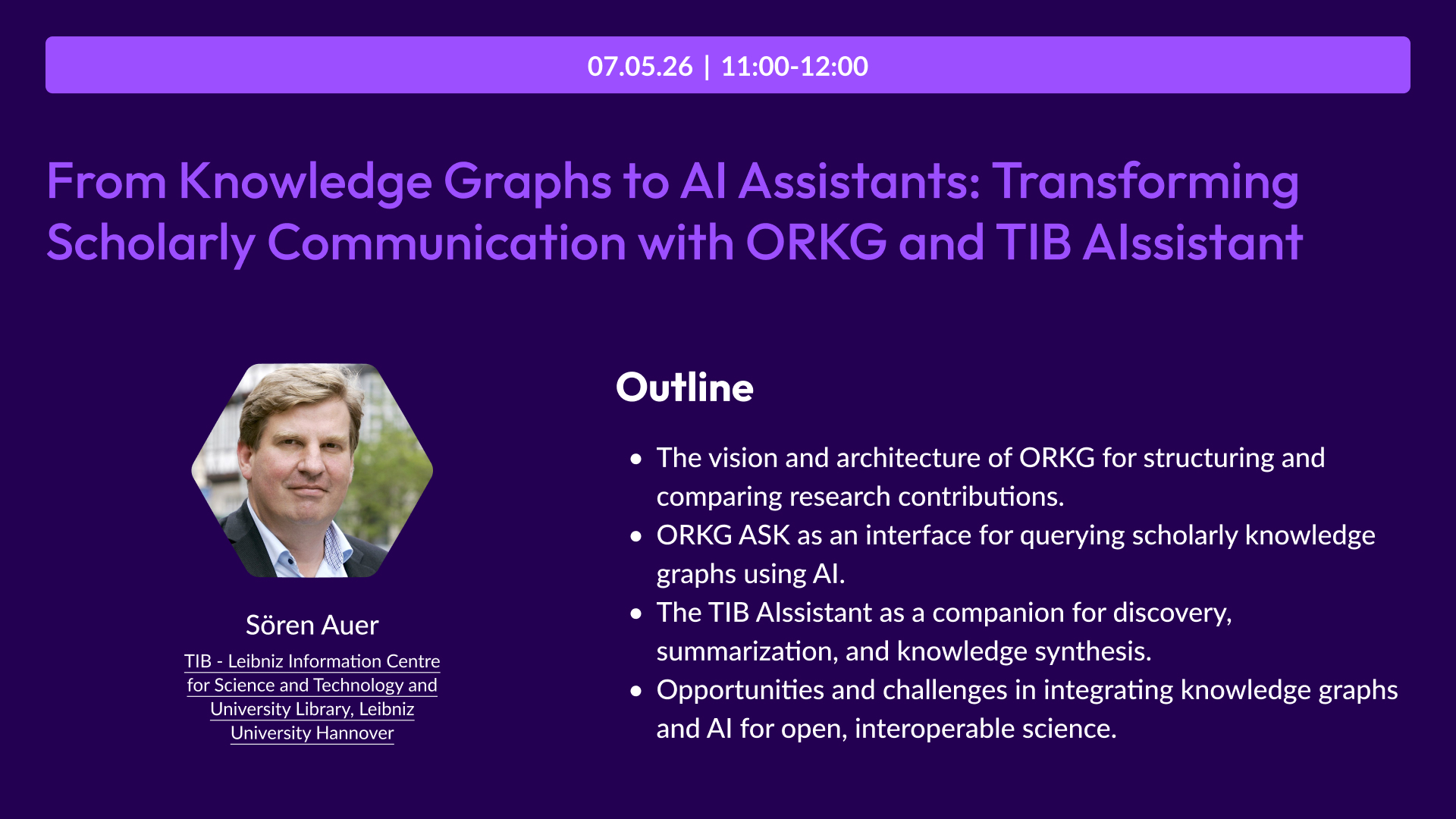
Date: 7 May, 11:00-12:00, Zoom
Speaker: Sören Auer, TIB - Leibniz Information Centre for Science and Technology and University Library, Leibniz University Hannover
Abstract: The digital transformation of research demands new approaches to organizing, accessing, and synthesizing scholarly knowledge. In this talk, we presents recent advances at TIB in building intelligent infrastructures for research, focusing on the Open Research Knowledge Graph (ORKG), ORKG ASK, and the TIB AIssistant. ORKG structures scholarly contributions as machine-actionable knowledge, enabling comparison, exploration, and reuse beyond traditional publications. ORKG ASK extends this paradigm by allowing users to query research knowledge using natural language, bridging the gap between human questions and structured data. Complementing this, the TIB AIssistant integrates large language models with trusted scholarly resources to support researchers throughout the knowledge lifecycle: from discovery to analysis and synthesis. Together, these technologies illustrate how knowledge graphs and AI can reshape scholarly communication, improve transparency, and accelerate interdisciplinary research in the digital age.
DiTraRe Interdisciplinary Symposium 2: 6-7 April 2027

Save the date for our second Interdisciplinary Symposium on Digitalisation of Research, which will take place in Karlsruhe at KIT from 6 to 7 April 2027!
DiTraRe Symposium on Digitalisation of Research 2025

On December 2 and 3, 2025 the DiTraRe Symposium on Digitalisation of Research took place at the Centre for Art and Media (ZKM) in Karlsruhe. Through a keynote presentation, panel discussions, and interactive sessions, participants were exploring the fast-evolving landscape of digital research - from AI-driven data analysis and curation, open science practices to groundbreaking technological advancements that have shaped how we conduct and share knowledge. We exchanged ideas with leading experts, engage in lively debates, and helped chart the future of research in an increasingly digital world.

The work programme of DiTraRe is organised as a matrix: Four research clusters (RC) each start from a scientific use case that raises concrete questions. These questions are examined along the four dimensions. Subsequently, (i) an accordingly coherent solution is developed which (ii) is evaluated by the use case partners, (iii) the questions are generalised and placed in the overall context of the DiTraRe in order to move from the concrete to a more abstract level, (iv) ensuring the transferability of the research results to other disciplines.